Up-to-date guidelines for fertility preservation in gender-affirming care patients



Because gender-affirming hormone therapy (GAHT) is likely to affect fertility, it is critical that individuals seeking gender-affirming care receive correct and complete information about their fertility options early in and throughout their care. Here, we’ll review the WPATH Standards of Care for reproductive health and fertility preservation, as well as guidelines on fertility for trans […]
Because gender-affirming hormone therapy (GAHT) is likely to affect fertility, it is critical that individuals seeking gender-affirming care receive correct and complete information about their fertility options early in and throughout their care. Here, we’ll review the WPATH Standards of Care for reproductive health and fertility preservation, as well as guidelines on fertility for trans and gender non-conforming individuals from 3 other major medical organizations (AAP, APA, and ASRM).
A note — As Legacy’s expertise lies in the andrology (sperm) field, there’s a special focus here on sperm freezing for trans femme and GNC patients.
Key takeaways
- The World Professional Association for Transgender Health Standards of Care outline early, personalized counseling on fertility impacts and options.
- Guidance from ASRM, AAP, and APA emphasize that gender identity should never be a barrier to accessing fertility services, and that effective discussions about fertility should include financial factors, availability of services, and emotional/social impacts.
- Many transgender and nonbinary individuals still receive little or inaccurate information about fertility risks and preservation options, even though major medical organizations stress its importance in gender-affirming care.
- Gender-affirming treatments can impact fertility, so timely education is critical. Patients should be informed early in the process about fertility preservation options.
Jump to:
- WPATH Standards of Care for reproductive health and fertility preservation
- ASRM Committee Opinion on fertility services for transgender and nonbinary patients
- AAP Policy Statement on care for transgender and gender-diverse children and adolescents
- APA Guidelines for discussing family formation with trans and gender non-confirming patients

WPATH Standards of Care for reproductive health and fertility preservation
In a 2022 article published in the International Journal of Transgender Health, the World Professional Association for Transgender Health (WPATH) issued the following guidelines for fertility preservation.1
First — “Health care professionals who are treating transgender and gender diverse people and prescribing or referring patients for hormone therapies/surgeries should advise their patients about:
- Known effects of hormone therapies/surgery on future fertility.
- Potential effects of therapies that are not well studied and are of unknown reversibility.
- Fertility preservation (FP) options (both established and experimental).
- Psychosocial implications of infertility.”
Importantly, this guideline leaves space for what we don’t know yet — which in this space, is actually a lot.
For example, while we know that sperm production is likely to be reduced or even halted while a patient is taking estrogen or testosterone blockers, we don’t yet know if that impact is reversible for all patients. We don’t know how long it may take to recover sperm production (a period during which the patient cannot take gender-affirming hormones, which may lead to a distressing reversal of the medication’s feminizing effects.) We also don’t know the impact of long-term puberty suppression (using “puberty blockers”) on fertility.
For TGNC patients who want — or might want — a family, these unknowns are very important risks to discuss when considering fertility preservation.
Next — “Health care professionals should refer transgender and gender diverse people interested in fertility preservation to providers with expertise in fertility preservation for further discussion... Transgender care teams should partner with local reproductive specialists and facilities to provide specific and timely information and fertility preservation services prior to offering medical and surgical interventions that may impact fertility.”
This can be easier said than done. In 2016, the National Center for Transgender Equality released a survey that found 1 in 4 transgender individuals had to “teach” their healthcare providers about trans people in order to receive appropriate care.2 In nearly a decade since, progress has certainly been made in terms of trans-specific healthcare needs, but there is still a significant way to go. Finding a gender-affirming, trans-informed fertility provider for referrals may take some time and vetting.
Next: “Health care professionals should counsel pre- or early-pubertal transgender and gender diverse youth seeking gender-affirming therapy and their families that currently evidence-based/established fertility preservation options are limited.”
For people with sperm, this means that if they haven’t started puberty yet, they can’t produce a semen sample via ejaculation for easy cryopreservation. There are new, experimental procedures, like testicular tissue preservation, that may be an option for younger patients, but success rates are unknown.
And lastly: “Medical providers should discuss contraception methods with transgender and gender diverse people who engage in sexual activity that can result in pregnancy.”
This is such an important point. While estrogen and T-blockers typically reduce sperm production significantly, there is no guarantee that production will be halted altogether — gender-affirming hormones aren’t birth control.
ASRM Committee Opinion on fertility services for transgender and nonbinary patients
In a statement published in the April 2021 edition of Fertility and Sterility, the ethics committee of the American Society for Reproductive Medicine noted that historically, transgender people sought gender-affirming care after having children.3 However, more recently, many transgender individuals seek GA care during reproductive age. These patients may wish to have genetically related children at some point. Therefore, “physicians are encouraged to advise their transgender patients about options for fertility preservation and reproduction.”
ASRM’s Committee Opinion made the following observations and recommendations:
First: “Many transgender and nonbinary persons have the same interests in having children and accessing fertility services for fertility preservation and reproduction as other persons.”
This is statistically supported, although data is limited. In one study from Germany, researchers found that between 47 and 69% of trans patients desired to be parents in the future.4 This is similar in numbers to the general population of young childless people, of which (according to a Pew survey) 45–57% definitely want children and 28–32% aren’t sure.5
Next: “Providers should offer fertility preservation counseling to individuals before gender transition.” This is in alignment with WPATH.
As the governing body for fertility providers that actually help patients create pregnancies, ASRM offers some reassuring insight on the outlook of trans parenting: “Current data do not support restricting access of transgender persons to reproductive technologies, and concerns that children are harmed from being raised by transgender parents. Programs should ensure that transgender patients who seek fertility services are informed about the limited but reassuring data on long-term outcomes for patients and their offspring.”
“Transgender identity/status by itself should not bar a person from accessing fertility preservation and assisted reproductive services,” the committee wrote. “Unless other factors disqualify transgender persons from fertility services and based on empirical evidence rather than stereotypes or bias, reproductive services should be offered to all interested transgender or nonbinary individuals.”3

Make fertility care easy and affordable for your patients.

AAP Policy Statement on care for transgender and gender-diverse children and adolescents
The American Association of Pediatrics (AAP) does not take a specific stance on fertility preservation. However, the AAP acknowledges that both pubertal suppression and cross-sex hormone treatment involve unknown risks to fertility. “The effect of sustained puberty suppression on fertility is unknown,” the organization says.
The AAP also acknowledges that “youth who identify as [trans or gender diverse] face several barriers within the health care system, especially regarding access to care.”6

APA Guidelines for discussing family formation with trans and gender non-confirming patients
The American Psychological Association’s guidelines for transgender and gender-nonconforming individuals encourages psychologists “to attend to the parenting and family-building concerns of TGNC people.”7
APA’s recommendations for discussing family formation with TGNC patients include the following:
- When TGNC people consider beginning hormone therapy, psychologists may engage them in a conversation about the possibly permanent effects on fertility to better prepare TGNC people to make a fully informed decision.
- In discussing family-building options with TGNC people, psychologists are encouraged to remain aware that some of these options require medical intervention and are not available everywhere, in addition to being quite costly.
- Psychologists may explore the physical, social, and emotional implications should TGNC people choose to delay or stop hormone therapy, undergo fertility treatment, or become pregnant. This is especially relevant to those who don’t preserve gametes prior to starting hormone therapy, and may have to pause for an indefinite period for fertility preservation, fertility treatment, or trying to conceive.
Are trans and gender non-conforming patients getting adequate information about fertility risks and preservation?
Despite these official guidelines and standards of care, a large percentage of transgender and non-binary patients report receiving inadequate counseling on fertility.
In a November 2024 study published in AJOG Reports:7
- 85% (34 out of 40) either desired or were unsure about future parenthood.
- 23% of transgender individuals surveyed reported that no healthcare professional had ever discussed fertility preservation with them prior to starting gender-affirming care.
- . Participants specifically mentioned that their discussions lacked information about:
What does this mean? Just having the conversation about the fertility risks of GAHT may not be enough without giving patients a care plan for fertility preservation. Providers who want to give their patients comprehensive information and fully align with WPATH Standards of Care should also:
- Provide TGNC patients with a referral to a gender-affirming fertility expert.
- Provide some information on cost, and refer patients to a finance counselor who can explore coverage options if possible.
- Give a full picture of the potential impact of GAHT on sperm production, including what we don’t yet know.
“The goals for family-building and [fertility preservation] are diverse among the transgender community, and counseling should be tailored towards individuals’ goals,” researchers of the 2024 study wrote. “Counseling efforts should focus on cost, insurance coverage, effects of GAHT on fertility, locations for [fertility preservation], and the adoptive process. All transgender individuals should be offered counseling but have the option to opt-out.”
References
- James et al. “The Report of the 2015 U.S. Transgender Survey,” 2016.
- Coleman et al. “Standards of Care for the Health of Transgender and Gender Diverse People, Version 8,” 2022.
- Ethics Committee of the American Society for Reproductive Medicine. “Access to fertility services by transgender and nonbinary persons: an Ethics Committee opinion,” 2021.
- Auer et al. “Desire to Have Children Among Transgender People in Germany: A Cross-Sectional Multi-Center Study,” 2018.
- Pew Research Center. “2023 PEW RESEARCH CENTER’S AMERICAN TRENDS PANEL,” 2023.
- Rafferty et al. “Ensuring Comprehensive Care and Support for Transgender and Gender-Diverse Children and Adolescents,” 2018.
- American Psychological Association. “Guidelines for Psychological Practice With Transgender and Gender Nonconforming People,” 2015.
- Walker et al. “Thoughts and opinions about fertility preservation and family building from the transgender community—an interview-based approach,” 2024.
Find what's right for you

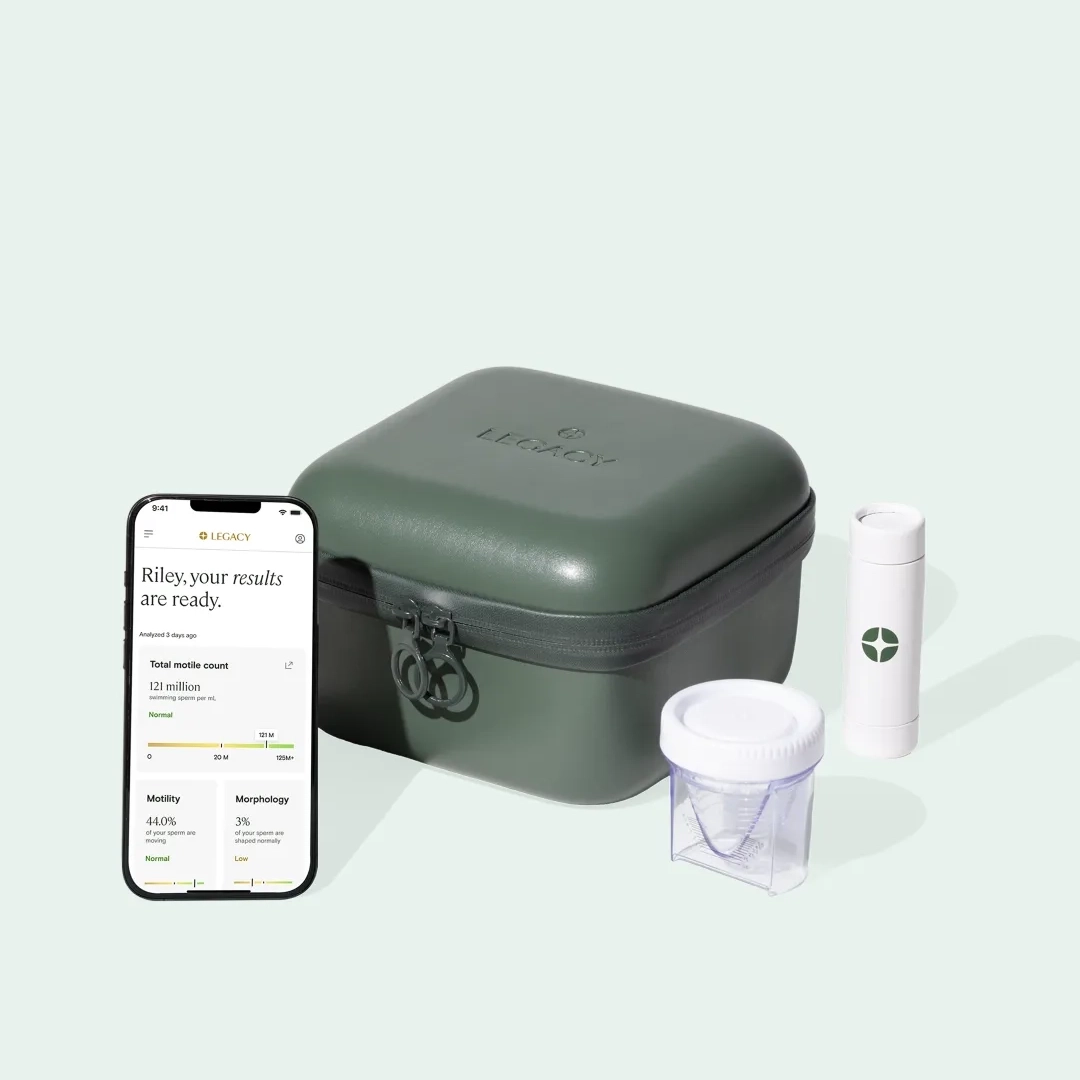
Standard Semen Analysis
$295
Key features

Semen volume
Sperm concentration & count
Motility
Morphology