The two-week wait


After a pregnancy attempt, the two-week wait stands between you and finding out if you’re pregnant. We’ll help you understand and get through the process.
If you’re trying to conceive, you might be familiar with the concept of the “two-week wait” — even if you don’t call it by that name. The two-week wait, AKA the “TWW,” refers to the period following ovulation, during which a person or couple is waiting to see if they’ve gotten pregnant. The two-week wait can be full of excitement, anxiety, and anticipation while you or your partner wait to take a pregnancy test, or for your period to begin.
This article will help you understand the timing of ovulation and pregnancy, symptoms to look for during the two week wait, ways to manage stress and anxiety during this time, and how you can improve your chances of getting pregnant.
Key takeaways
- The two-week wait is the time period between a pregnancy attempt and being able to find out whether or not you’re pregnant. Taking a pregnancy test too early during this period may yield false results.
- It’s important to take care of yourself and find ways to reduce your stress during this interval.
- If you’re not getting pregnant as quickly as you’d hoped, there are some easy steps you can take to check in on your fertility health and improve your chances.
Trying to conceive timing
To understand the two-week wait, it’s first important to know what goes on during your or your partner’s ovulation and menstrual cycle.
The menstrual cycle starts on the first day of each period and generally lasts about 24 to 38 days (with an average of 28 days). The time varies between people and may also be different each month.
A typical cycle looks like this:
Days 1–5: Menstruation, commonly known as a “period.” The uterus sheds its previous lining through vaginal bleeding.
Days 5–14: Follicular phase. Increased estrogen hormone levels prompt follicles (immature eggs) in the ovaries to mature.
Day 14: Ovulation. Luteinizing hormone (LH) increases during this time to trigger ovulation. The follicle releases an egg. If it’s not fertilized by sperm, the egg only survives for around 12 to 24 hours following ovulation.
Day 15–28: Luteal phase. During this period, progesterone drives the uterine lining to thicken in preparation for a potential pregnancy. If fertilization occurs, the fertilized egg may implant in the uterine lining. If no fertilization occurs, estrogen and progesterone hormone levels will decrease and menstruation will occur, and the cycle restarts.
This process repeats throughout your or your partner’s life, except during pregnancy and sometimes when breastfeeding. The cycle will continue until menopause around age 52.
In order to get pregnant without medical assistance, you’ll need to have sex just prior to or during ovulation. Sperm can survive in the female reproductive system for about 3–5 days, so the 5 days prior to ovulation are the best days to have sex to get pregnant. This is known as the “fertile window.”
When to take an at-home pregnancy test
A pregnancy test works by detecting the human chorionic gonadotropin (hCG) hormone in a person’s urine. The body starts releasing this hormone when a fertilized egg implants in the uterus lining. It can take 10–14 days or more for hCG to reach detectable levels in a person’s urine after fertilization. That’s typically about the point when you or your partner would expect the next menstrual period to begin.
The average home pregnancy test can detect hCG if the concentration is at least 25mIU per mL of urine. Most pregnancies don’t exceed this level until about 13 days past ovulation. The majority of tests will be most accurate starting from this point. Therefore, if you’re trying to conceive naturally, it’s best to wait until at least the first day of your or your partner’s expected period to take an at-home pregnancy test (hence, the “two-week wait”).
Source: Johnson et al, 2009.
Some more sensitive tests may be able to detect hCG sooner, but the accuracy and reliability of those tests may be questionable.
What if you aren’t sure when you ovulated or when your next period should start, or your cycles are irregular? Wait at least 14–21 days after having unprotected sex to take a home pregnancy test.
If you do a home pregnancy test too soon
It’s possible for at-home pregnancy tests to give a false negative result if you take the test too soon, don’t precisely follow the instructions, are taking certain medications that could affect the results, or if the test has expired.
If you take a pregnancy test less than two weeks after ovulation or unprotected sex and it’s negative, that doesn’t mean you’re not pregnant. Wait a few days and try taking a test again.
The “two-week wait” is this period — after ovulation and unprotected sex — when a person or couple is waiting until a home pregnancy test can accurately tell them whether or not they’re expecting.
When can a blood test for hCG tell me I’m pregnant?
Blood testing may be able to detect pregnancy earlier than a home pregnancy test that uses urine hCG levels. That’s because blood tests can typically detect hCG levels as low as 10 IU/mL.
However, blood testing is expensive and slow. Typically, blood testing isn’t done until after a positive home pregnancy test, to confirm the pregnancy is progressing well.
Having trouble getting pregnant? The answer may be one test away.

The two-week wait after fertility treatment
The two-week wait happens after sexual intercourse, but it also occurs after a fertility treatment like intrauterine insemination (IUI) or in vitro fertilization (IVF).
Two-week wait after IUI
IUI is a type of assisted insemination. During this procedure, semen is processed and injected directly into the uterus, helping it get closer to the egg and hopefully facilitating fertilization. Intrauterine insemination is done at the time of ovulation to increase the chances of achieving pregnancy.
After the IUI procedure, the process of fertilization and implantation is exactly the same as during unassisted conception. A blood pregnancy test about two weeks later should be able to identify whether an IUI was successful.
Some IUI procedures involve medication, such as a “trigger shot,” that spurs ovulation. This trigger shot is sometimes hCG — the very same hormone that home pregnancy tests are measuring. Therefore, taking a pregnancy test too soon after an IUI may result in a false positive result, as the hCG from the trigger shot hasn’t cleared the system yet.
It may be difficult to wait two weeks after your IUI to take a pregnancy test, but for the most accurate results, it’s best to hold off until your doctor can see your blood work.
Two-week wait after IVF
IVF is a method of assisted reproduction in which an eggs are surgically removed from the uterus and combined with sperm outside the body to create embryo(s). Then, an embryo is implanted into the uterus in an embryo transfer procedure, typically done about 5 days after ovulation.
Having an embryo transfer doesn’t automatically mean someone is pregnant. The process only results in a pregnancy if the embryo successfully attaches to the lining of the uterus. As a result, the embryo transfer begins the two-week wait to know if the procedure led to a pregnancy. Typically about two weeks after the embryo transfer, a blood pregnancy test will confirm a pregnancy.
Just as with IUI, taking an hCG trigger as part of your IVF protocol can interfere with the results of a home pregnancy test, and can give a false positive result if you take the test too early. It’s recommended to wait for the blood test at your IVF clinic for the most reliable results.
What to expect during the two-week wait
You’ll likely feel a variety of emotional and physical symptoms during your two-week wait. It’s normal to feel anxious during the two-week wait. You may feel a mixture of hope, worry, excitement, stress, and frustration.
Symptoms of early pregnancy — or menstruation
During the two-week wait, you may feel physical symptoms, including:
- breast tenderness
- cramping
- bloating
- tiredness
You or your partner may be tempted to analyze every symptom as a sign of early pregnancy. It can be frustrating, but important, to remember that early pregnancy signs mimic PMS symptoms, making it hard for a person to tell if they’re pregnant during the two-week wait.
The most reliable symptom of early pregnancy is a missed or late menstrual period. If your or your partner’s period seems to be late by a day or more, that’s a good sign you may be pregnant and that it’s time to take a pregnancy test. (Tracking cycles will give you a better idea of when that period is expected.)
If you or your partner have chest pain, a fever, shortness of breath, or lower stomach pain, it’s important to call your doctor.
Managing stress and anxiety during the two-week wait
If you’re feeling anxious about trying to conceive or infertility, that anxiety may be amplified during the two-week wait. This is a period in which all you can really do is wait — that lack of control can be especially difficult for some people!
It may help to:
- Share your feelings with your partner, or lean on your friends and family for support.
- Connect with people who are going through the same thing, such as through online groups or social media.
- Plan ahead to do things you enjoy. It may help to schedule something exciting during the two-week wait as a way to distract yourself from worrying.
- Meditate, do yoga, or try some exercise (check with your doctor to find out what’s appropriate).
- Talk with a therapist, especially one who specializes in infertility issues.
How to improve your chances of getting pregnant
If you’ve found yourself going through more two-week waiting periods than you would have hoped, there are some actions you can take to better understand what’s going on with your fertility, and improve your chances of conceiving.
- Get a semen analysis. Sperm health is half the equation when it comes to getting pregnant. Proactively testing your or your partner’s sperm can give you some invaluable information that can help you understand why it’s taking longer than expected to get pregnant. With Legacy, you can do a semen analysis from home.
- Improve sperm health. Lifestyle changes and male prenatal supplements can both help optimize sperm quality — not just how many sperm you or your partner are making, but how healthy those sperm are. Learn more about improving sperm health and trying adding specific nutrients to your diet with male fertility supplements.
- Track ovulation. You may be having sex, but are you sure you or your partner is actually ovulating? There are a few simple ways to track ovulation — monitoring hormone levels with urine tests, using a wearable like the Ava bracelet, or taking a daily basal body temperature can all help you understand whether ovulation is likely.
Get the timing right. For the best chance of pregnancy, you should be having sex every 1–2 days during the fertile window (that 5 day period before ovulation that we explained above). Off-cycle ovulation is possible, too, so a general increased frequency of sexual intercourse can’t hurt.
Find what's right for you

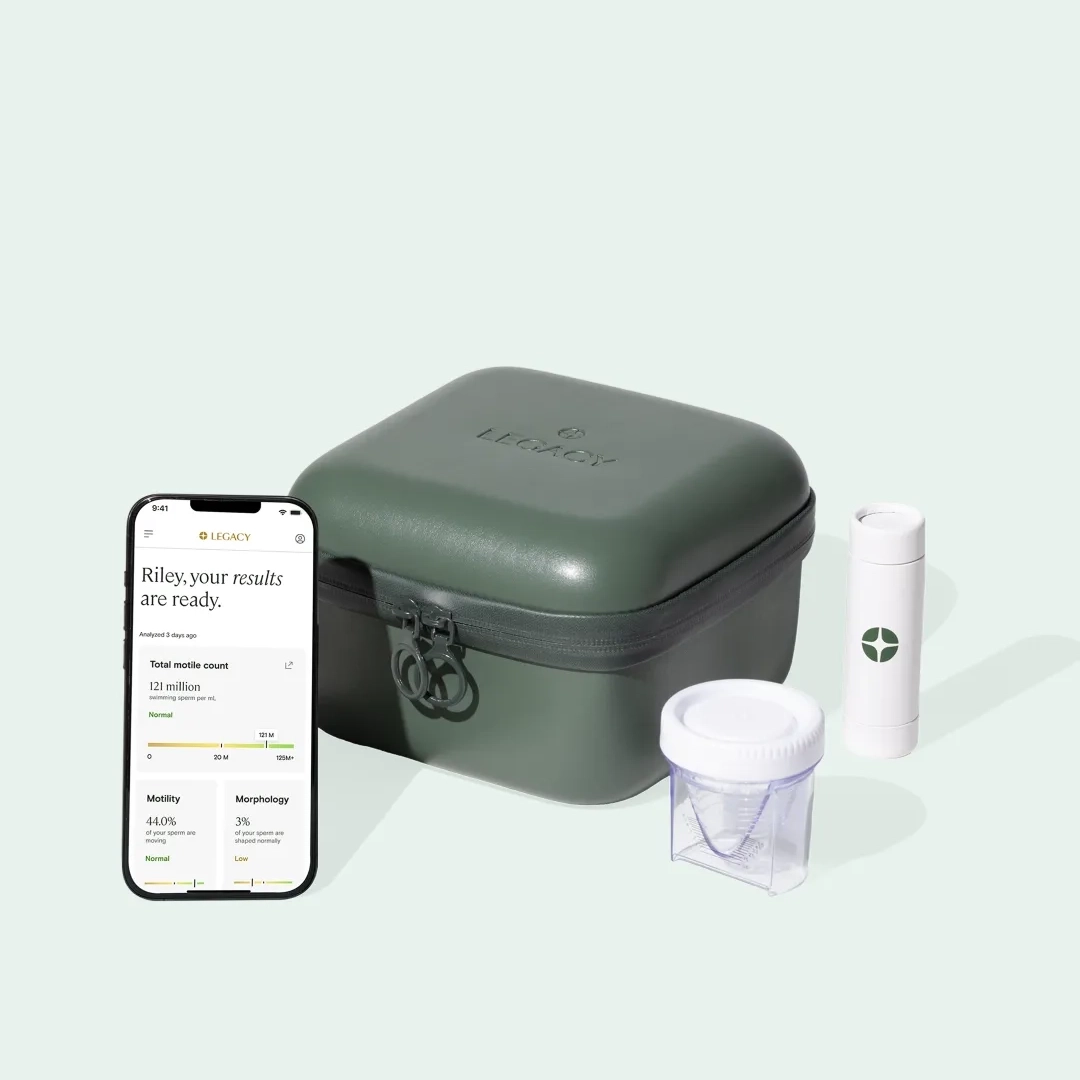
Standard Semen Analysis
$295
Key features

Semen volume
Sperm concentration & count
Motility
Morphology