How long does sperm last?



How long sperm lives—inside the body or on other surfaces—is more than just a “fun fact.” It can actually impact your ability to conceive. Knowing that sperm live for 3–5 days in the female reproductive system, for example, means you could have sex several days before your partner ovulates and still result in a pregnancy. Let’s explore how long sperm can live in different scenarios, and bust a few myths along the way.
How long sperm lives—inside the body or on other surfaces—is more than just a fun fact. It can impact your ability to conceive. Knowing that sperm live for 3–5 days in the female reproductive system, for example, means you could have sex several days before your partner ovulates and still result in a pregnancy.
Let’s take a look at sperm lifespan in the female reproductive tract, on surfaces, and in cryostorage—plus what it means for fertility and conception.
Key takeaways
- Sperm can live up to 5 days inside the female reproductive tract, especially around ovulation, when cervical mucus and cervical crypts help preserve and store sperm.
- Sperm die quickly outside the body, typically within minutes in hot environments and within an hour on dry surfaces.
- Sperm quality declines during prolonged abstinence, even though sperm count increases.
- Frozen sperm can remain viable for decades.
How long can sperm last inside the female body?
Once ejaculated or inserted into the female reproductive tract, sperm live about three days. This depends on the menstrual cycle. With the right timing, sperm could last up to five days.1
This can depend on the consistency of cervical mucus. During ovulation, changes in hormones alter mucus composition. Instead of its characteristic opaque texture, the cervical mucus thins, providing the right hosting environment to protect sperm without preventing movement.
The cervix also has another method for holding on to sperm around the time of ovulation: cervical “crypts,” small channels off the cervical canal. These crypts can serve as temporary storage spaces for sperm,2 which is released over time, increasing the chances of fertilization.
This is important for timing sex when you’re trying to conceive. According to the American Society for Reproductive Medicine, the fertile window is typically the five days leading up to ovulation and the day of ovulation itself. Most women ovulate about 12 to 14 days before the start of their next period, although cycles can vary.3
Read more about how often you should have sex when trying to conceive.
This also explains why you can have sex one day, and not fertilize the egg until days later—and in fact, this is the case with many pregnancies, as pinpointing ovulation precisely can be challenging.
How long does sperm live on skin, clothing, or in water?
Everyone knows the urban myth: two teenagers make out in a hot tub, and one ejaculates. The sperm swim through the water into the other’s vagina, and surprise! Pregnancy, even though they didn’t have sex.
Luckily, this isn’t reality. Sperm are highly unlikely to:
- swim that far. The female reproductive system actually helps coax sperm along. Without this assist, they’re not going far.
- survive in heat. Studies beginning around 19414 suggest temperatures above that of the human body affect sperm life and quality.5 Although these studies measure scrotal temperature, we can conclude that heat itself has a negative effect on sperm’s viability.
In all likelihood, sperm ejaculated into a hot tub or bath would not live long enough to land inside a vagina—they’d survive only a few minutes.
Even in a room-temperature or body-temperature environment, sperm are unlikely to survive more than an hour or so outside the body. Sperm are carried in semen, a fluid that nourishes and buffers them; once semen has evaporated, there’s nothing to protect sperm. Sperm exposed to dry surfaces like bedding, clothing, or hands typically die within minutes. The World Health Organization (WHO) reports that sperm motility is extremely sensitive to drying, and once dried, sperm cannot rehydrate or “revive.”6
You're ready to start a family. But are your sperm?
Can sperm testing kits keep sperm alive during shipping?
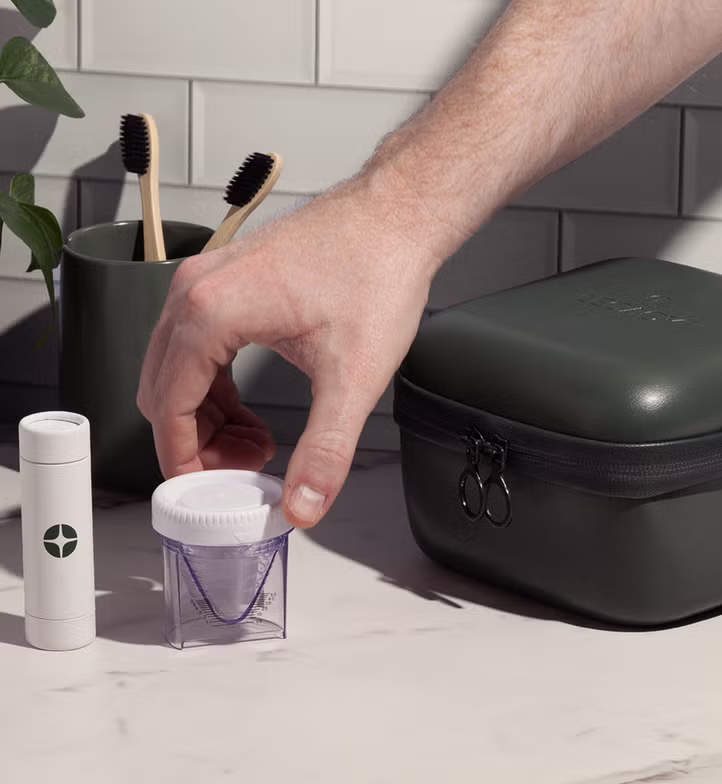
Mail-in sperm testing kits like Legacy’s use transport media, an ingredient that’s clinically proven to protect sperm during overnight shipping. Additionally, our kits are insulated and extensively tested to ensure samples are not susceptible to sudden temperature changes in transit. These measures extend the lifespan of sperm outside the body to at least 48 hours, without significantly affecting the health of sperm.
Learn more about the science of at-home sperm testing.
How long does sperm last in the testicles?
Spermatogenesis, or the process of producing sperm, takes about 72 days, and it’s happening continuously in the testicles. Once they’re mature, sperm live in “storage” in the testicles—specifically, in the cauda epididymis, a coiled tube behind the testicles—for as long as a few weeks. After that, they’re reabsorbed into the body.
But while in storage, sperm quality decreases rapidly. Studies indicate that DNA fragmentation and mitochondrial damage increase after 5 days of abstinence from ejaculation, and motility decreases after about 7 days.7

The decline in sperm quality during extended periods of abstinence is caused by increased oxidative stress. As sperm age in storage, reactive oxygen species (ROS) accumulate, damaging sperm DNA and reducing their ability to fertilize an egg.
That’s why an extended period of abstinence isn’t beneficial for sperm. If you’re trying to conceive, it’s best to have sex every 1–2 days during your partner’s fertile window.
How does freezing affect sperm lifespan?
Freezing sperm protects its quality. (We’re not talking about sticking your sperm in your household freezer—medical cryopreservation is done with liquid nitrogen at a temperature of -196ºC.)
A 2019 study8 examined the long-term effect of freezing on human sperm and pregnancy outcomes. Looking at over 119,000 donor sperm samples, researchers found:
- Cryostorage lasting up to 5 years had no effect on the survival rate of sperm.
- After 5 years, there was a small decrease in sperm’s survival rate (from 86% to 74% over 15 years). However, this had only a minor impact on birth rates when this sperm was actually used in insemination. Live birth rates for the group that stored for less than 5 years was 82%; for the group that stored for 6–15 years, the LBR was 80%.
Other studies show successful pregnancies using sperm frozen for even longer. One article in the Journal of Assisted Reproductive Technology reported on the birth of healthy twin girls via IVF using sperm that had been frozen for 40 years.9
The researchers behind the 2019 study concluded that “long-term cryostorage of semen in a human sperm bank does not affect clinical outcomes.” So we can safely say that, once frozen, sperm can last indefinitely.
Choosing to preserve your sperm
If you’re thinking of freezing your sperm, using an industry-leading sperm freezing facility can provide the best outcomes whenever you decide to become a parent. If you freeze with Legacy, your samples are stored at multiple facilities to mitigate any location-specific risks and monitored 24/7. This is one step you can trust to help keep your sperm safe and protect your chances of starting a family.
References
- Clubb. “Natural methods of family planning,” 1986.
- Insler et al. “Sperm storage in the human cervix: a quantitative study,” 1980.
- American Society for Reproductive Medicine. “Optimizing natural fertility,” 2022.
- Macleod et al. “The effect of hyperpyrexia on spermatozoa counts in men,” 1941.
- Soufir. “Hormonal, chemical and thermal inhibition of spermatogenesis,” 2017.
- World Health Organization. “WHO Laboratory Manual for the Examination and Processing of Human Semen, 6th ed.,” 2021.
- Comar et al. “Influence of the abstinence period on human sperm quality: analysis of 2,458 semen samples,” 2017.
- Huang et al. “Long-term cryostorage of semen in a human sperm bank does not affect clinical outcomes,” 2019.
- Szell et al. “Live births from frozen human semen stored for 40 years,” 2013.
Find what's right for you

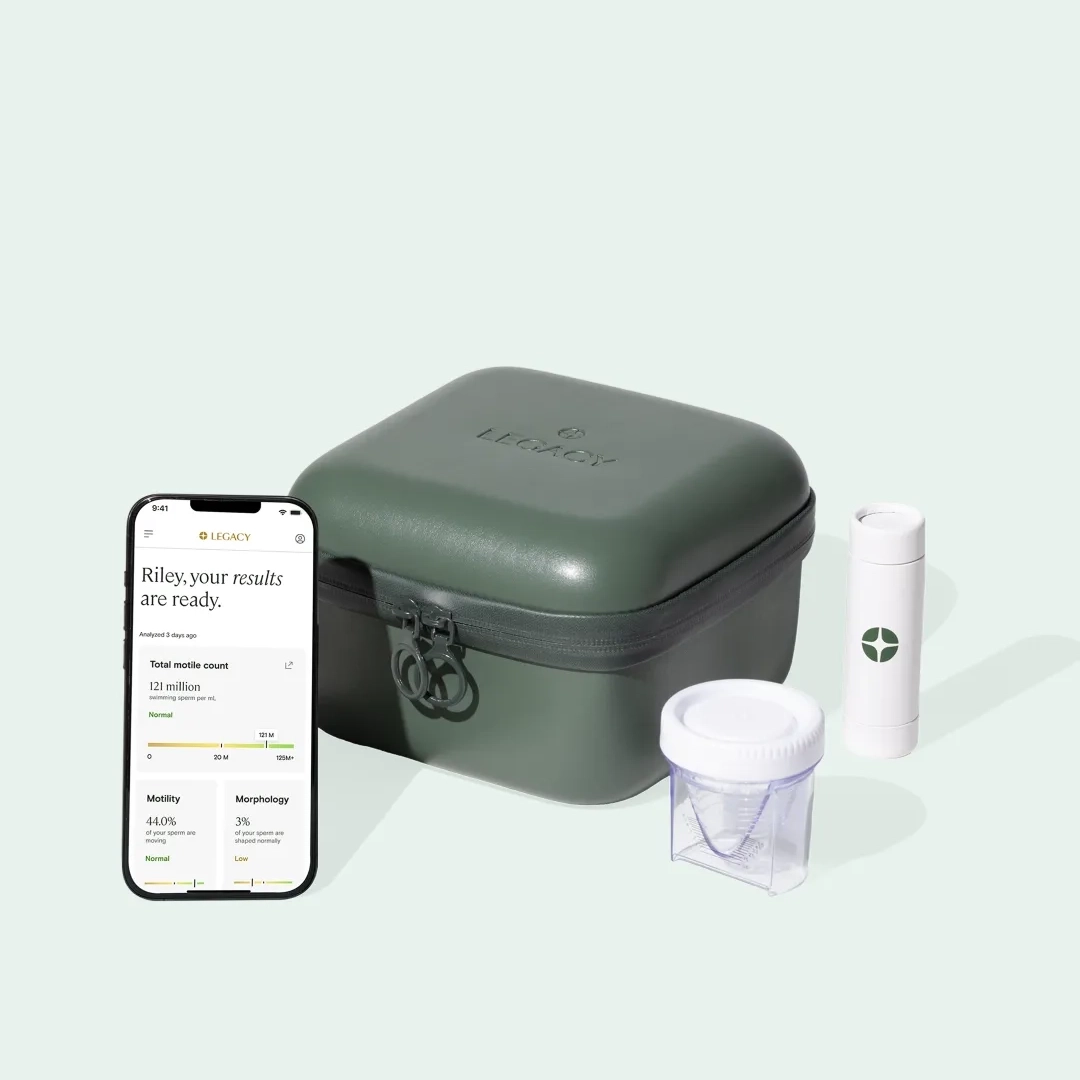
Standard Semen Analysis
$295
Key features

Semen volume
Sperm concentration & count
Motility
Morphology